Article written by Dr. Adolfo Alvino, MD.
Most allergic reactions are mild. A little itching, a few hives, a runny nose. But a smal l number turn serious fast, and those are the ones that scare us in the ER. At SignatureCare Emergency Center, our board-certified emergency physicians treat severe allergic reactions every week, from bee stings to peanut exposure to a first-time reaction to amoxicillin.
This guide walks you through what an allergic reaction looks like, how to tell mild from severe, and the exact point where you stop watching and start driving to the ER. We will also clear up the biggest myth we see: that Benadryl can stop a life-threatening reaction. It cannot.
What Is an Allergic Reaction? Mild vs. Severe
An allergic reaction happens when your immune system treats a harmless thing, a food, a drug, a sting, as a threat. Your body releases histamine and other chemicals. Those chemicals cause the itching, swelling, and rash you feel. In a severe allergic reaction, that release goes body-wide and starts to affect breathing and blood flow.
The word to know is anaphylaxis. It means the reaction has moved past the skin and is now a true emergency. Telling a mild reaction from a severe one is the single most useful skill here, so start with the table below.
| Mild reaction (watch closely) | Severe reaction (get help now) |
| A few hives or an itchy patch of skin | Hives spreading fast across the body |
| Runny nose, sneezing, watery eyes | Swelling of the lips, tongue, or throat |
| Mild stomach upset | Trouble breathing, wheezing, or a tight throat |
| Itching around a bite or sting | Dizziness, fainting, or a weak, fast pulse |
| Symptoms stay in one area | Vomiting plus rash plus a known trigger |
SkiptheWaitBook an Appointment Today
The 5 Stages of an Allergic Reaction
Reactions often climb in steps. Not every reaction hits all five, and a severe one can jump straight to the top in seconds. Knowing the ladder helps you catch trouble early.
- Stage 1: Skin signs. Itching, flushing, or a few hives near the exposure.
- Stage 2: Swelling spreads. Puffy lips, eyelids, or face. Hives cover more skin.
- Stage 3: Gut and whole-body. Cramps, nausea, vomiting, or a sudden sense of dread.
- Stage 4: Breathing and circulation. Wheezing, tight throat, dizziness. This is anaphylaxis.
- Stage 5: Anaphylactic shock. Collapse and dangerously low blood pressure. Call 911.
Allergic Reaction Symptoms & What They Look Like
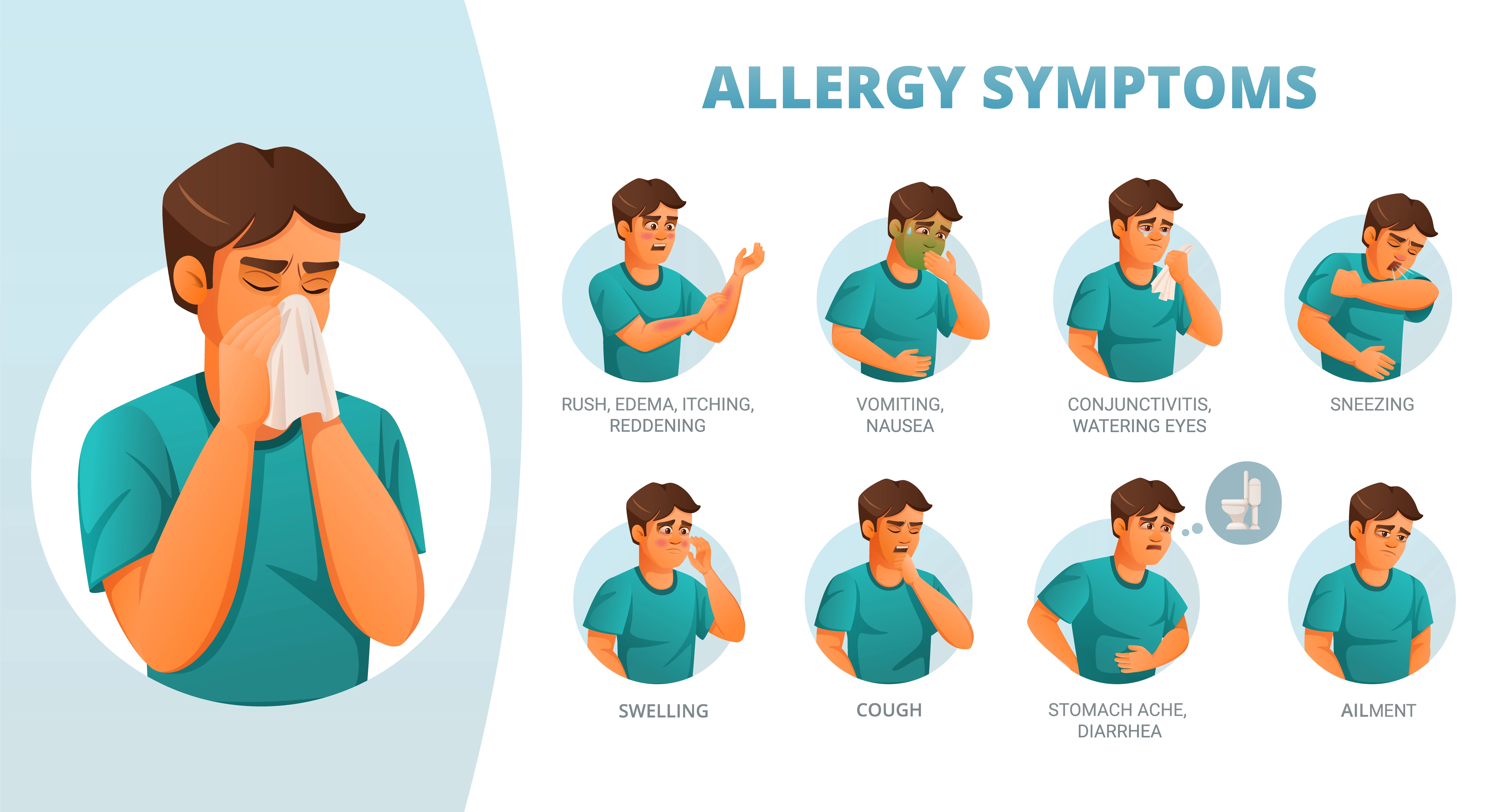
Symptoms usually start within minutes of exposure, though they can take an hour or more. The more body systems involved, the more serious the reaction. Here is what to look for, grouped by where it shows up.
- Skin: hives, redness, itching, or a raised rash. Skin is the most common first sign.
- Mouth and throat: swelling of the lips, tongue, or throat, trouble swallowing, or a hoarse voice.
- Breathing: wheezing, coughing, shortness of breath, or a tight chest. Treat this as urgent.
- Stomach: cramps, nausea, vomiting, or diarrhea, often alongside skin or breathing signs.
- Heart and head: dizziness, fainting, a racing or weak pulse, confusion, or a feeling of doom.
If you want to double-check what you are seeing, our overview of allergic reaction symptoms breaks the signs down further. The rule of thumb: skin only tends to be mild, but skin plus breathing or skin plus dizziness means severe.
Skin, Face, Lips & Eye Reactions
Skin reactions drive most allergy searches, and for good reason. They are visible, they itch, and they spread. Here is how to read them.
- Hives: raised, itchy welts that can move around the body. There are many causes of hives, and most are harmless, but hives that spread fast can signal a bigger reaction.
- Face and lips: puffy lips or cheeks are common. Watch closely, because swelling can move to the tongue and throat.
- Eye swelling: one or both eyelids can balloon quickly. Alarming to see, usually not dangerous on its own, but a sign the reaction is active.
The key question with any skin reaction is simple. Is it staying on the skin, or is it joined by trouble breathing or swelling near the airway? The first is a watch-and-wait. The second is an emergency.
Anaphylaxis & Anaphylactic Shock: The Danger Signs
Anaphylaxis is a severe allergic reaction that affects breathing and blood flow at the same time. Anaphylactic shock is its worst form, when blood pressure crashes and organs lose oxygen. You can read the clinical detail on anaphylaxis, but the short version is what matters in the moment: this is the reaction that kills, and it does so quickly.
Anaphylaxis can involve just two body systems, say skin and breathing, or it can drop blood pressure on its own. That is why any combination of the danger signs above counts. When in doubt, treat it as anaphylaxis.
How Long Does an Allergic Reaction Last (and How Fast Does It Start)?
Timing depends on the trigger and the route. A bee sting or an injected drug can spark symptoms in seconds. A food may take a few minutes to an hour. Here is a rough guide.
- Insect stings and IV or injected drugs: seconds to minutes.
- Foods like peanut, shellfish, or milk: minutes to about an hour.
- Oral medicines such as amoxicillin: minutes to a couple of hours, sometimes longer.
- Mild hives without other signs: can come and go for a few days as they clear.
SkiptheWaitBook an Appointment Today
When to Go to the ER, Call 911, or Try Urgent Care
This is the decision that matters most. A quick note on urgent care first: most urgent care clinics are not set up to manage full anaphylaxis, and many will send you on to an ER anyway. For a serious reaction, a freestanding emergency room is the right call. If you are still unsure whether is your allergic reaction an emergency, use the table below.
| Level | What you see | What to do |
| Mild | A few hives, itching, sneezing, no swelling or breathing trouble | Take an antihistamine, watch closely for one to two hours |
| Moderate | Spreading hives, facial or lip swelling, vomiting, a known trigger | Go to the nearest emergency room now, not urgent care |
| Severe | Trouble breathing, throat or tongue swelling, dizziness, collapse, or you used an EpiPen | Call 911 or get to the ER immediately |
Can a Reaction Come Back? EpiPen and Biphasic Reactions
Yes, and this surprises people. Even after epinephrine works and you feel fine, the reaction can return hours later. Doctors call this a biphasic reaction, a second wave that can arrive anywhere from one to 72 hours after the first, and it can be just as serious.
This is exactly why you still need the ER after using an EpiPen. The auto-injector buys time, it does not end the reaction. We watch you for a monitored period so that if a second wave hits, treatment is already in the room.
- Epinephrine can wear off before the allergic response is fully over.
- A delayed or biphasic wave can return without any new exposure to the trigger.
- ER observation is the safety net that catches that second wave early.
Treatment: Benadryl, Antihistamines, and Epinephrine
We see it often. Someone feels their throat tighten, takes a double dose of Benadryl, and waits. Antihistamines are simply too slow and too weak for anaphylaxis. They work on the itch, not on the airway or the blood pressure. Epinephrine is the only drug that reverses the dangerous part, and minutes matter.
For a mild reaction, an over-the-counter antihistamine is fine. For anything severe, epinephrine comes first. If you are ever unsure in the moment, our step-by-step guide on what to do during an allergic reaction walks through it calmly.
- Mild symptoms: an antihistamine and close watching for one to two hours.
- Severe symptoms: epinephrine right away, then 911, then the ER. Do not delay for pills.
- After epinephrine: always get evaluated, even if you feel better, because of biphasic reactions.
What Triggers a Severe Allergic Reaction?
Almost anything can trigger an allergy, but a short list causes most severe reactions. Knowing your trigger is the first step to avoiding the next reaction.
| Trigger type | Common examples | Note |
| Foods | Peanut, tree nuts, shellfish, milk, egg, soy, wheat, sesame | The leading cause of anaphylaxis in children |
| Insect stings | Bee, wasp, hornet, yellow jacket, fire ant | Reactions can worsen with each sting |
| Medications | Amoxicillin, penicillin, other antibiotics, aspirin, NSAIDs | Drug reactions can be immediate or delayed |
| Other | Latex, contrast dye, exercise, alpha-gal (tick-linked red meat allergy) | Some triggers have no clear cause (idiopathic) |
Drug and Antibiotic Allergies (Amoxicillin, Penicillin)
Antibiotic reactions are among the most searched, and amoxicillin and penicillin lead the list. A drug allergy can show up as a rash hours or even days after the first dose, or as full anaphylaxis within minutes. A delayed rash after amoxicillin is common in kids and is not always a true allergy, but any breathing trouble or swelling with a medicine is an emergency. Stop the drug and get seen.
Insect Stings and Bites
Stings from bees, wasps, and fire ants are a classic anaphylaxis trigger, and a reaction can grow more severe each time. If you are trying to judge a bite or sting, our guide on bug bites that become an emergency covers the warning signs. Swelling that spreads well beyond the sting, or any trouble breathing, means get help.
How SignatureCare Treats a Severe Allergic Reaction
When a severe allergic reaction comes through our doors, speed and monitoring are everything. Our board-certified emergency physicians are on-site 24/7, so care starts the moment you arrive. There is no appointment and no long lobby wait.
- Immediate epinephrine, given by injection, to reverse the reaction.
- Airway support and oxygen if breathing is affected.
- IV fluids and medication to steady blood pressure in anaphylactic shock.
- A monitored observation period to catch a biphasic second wave.
- A clear plan at discharge, including when you need an allergist and an auto-injector.
SkiptheWaitBook an Appointment Today
Who Is at Highest Risk
Anyone can have a severe reaction, but some people carry more risk. If this describes you or your child, keep an auto-injector close and have an action plan.
- A past severe reaction or anaphylaxis, which raises the odds of another.
- Asthma, which makes breathing complications more likely and more dangerous.
- Known food, drug, or insect allergies, especially several at once.
- Children and teens with food allergies, the group most affected by food anaphylaxis.
Testing and Preventing the Next Reaction
After the emergency is over, the goal is to stop it happening again. An allergist can confirm your trigger with skin or blood testing and build a plan. The American College of Allergy, Asthma & Immunology has solid guidance on anaphylaxis action plans worth reading with your doctor.
- Get tested to confirm exactly what you react to, so you can avoid it.
- Carry two epinephrine auto-injectors at all times, since one may not be enough.
- Write an action plan and share it with family, school, or coworkers.
- Read labels, ask about ingredients, and tell providers about drug allergies.
Wrapping Up
Most allergic reactions are mild, but the severe ones move fast. Learn the danger signs, trust them, and act. Use epinephrine first, call 911, and get to an ER, even if symptoms ease. SignatureCare's board-certified emergency physicians are ready 24/7, with no appointment and a short wait. When a reaction turns serious, minutes matter, so do not wait it out.
Find a 24/7 Allergic Reaction ER Near You in Texas
SignatureCare operates Severe Allergic Reaction emergency rooms across Texas. Find the ER location nearest you and walk in any time.
North Texas: Frisco · Allen · Flower Mound · McKinney · Preston - Plano
Central Texas: College Station · Killeen
East Texas: Texarkana
Frequently Asked Questions
What are the first signs of a severe allergic reaction?
Early danger signs include trouble breathing, swelling of the lips, tongue, or throat, a fast spreading rash, dizziness, and a weak or racing pulse after a trigger.
What are the 5 stages of an allergic reaction?
Reactions can climb from skin signs, to spreading swelling, to gut symptoms, to breathing and circulation trouble (anaphylaxis), and finally anaphylactic shock.
How long does an allergic reaction last?
Most reactions start within minutes to an hour and settle within a day or two with treatment. Mild hives may come and go for a few days as they fade.
Does Benadryl stop a severe allergic reaction?
No. Antihistamines like Benadryl ease mild itching and hives but cannot stop anaphylaxis. Only epinephrine reverses a severe reaction, so use it first.
Do I still need the ER after using an EpiPen?
Yes. Epinephrine buys time but does not end the reaction, and a second wave can return hours later. Always get evaluated after using an auto-injector.
Can an allergic reaction be delayed or come back?
Yes. A biphasic reaction can return one to 72 hours later without new exposure. Some drug reactions also appear hours or days after the first dose.
When should I call 911 for an allergic reaction?
Call 911 for trouble breathing, throat or tongue swelling, fainting or collapse, or any time you have used an epinephrine auto-injector.
-----------------------------------------------------------------------------

Dr. Adolfo Alvino, MD, is a board-certified emergency medicine physician based in the Midland-Odessa area in Texas and the Medical Director of SignatureCare Emergency Center in Odessa, TX. He graduated from the Albert Einstein College of Medicine of Yeshiva University in New York and has been in practice for over 10 years. Dr. Alvino specializes in emergency medicine.