Article written by Dr. Adolfo Alvino, MD.
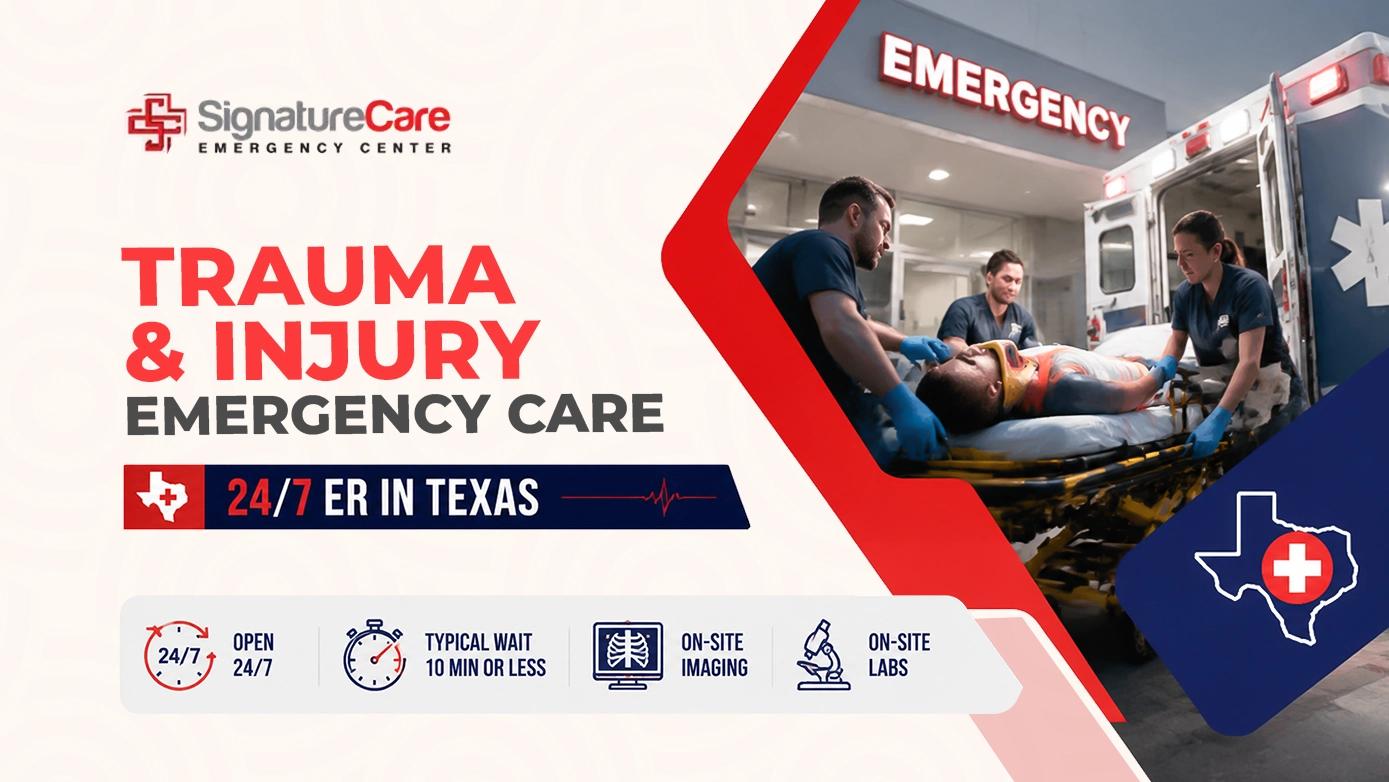
A deep cut that will not stop bleeding, a bone that looks bent, a serious burn, or any hard hit to the head or neck needs emergency care now. SignatureCare Emergency Center provides trauma and injury emergency care 24/7 at freestanding ERs across Texas, with board-certified ER physicians, on-site X-ray, CT scan, and lab, and a typical wait of 10 minutes or less.
Injuries force fast decisions with no time to research. Is this stitches or a bandage? A sprain or a break? Urgent care or the ER? Call 911 for severe bleeding, suspected spine injuries, or major trauma.
This guide answers those questions before you need them, from an ER team that treats them every single day.
What Counts as a Trauma or Injury Emergency?
A trauma or injury emergency is any sudden physical injury that threatens life, limb, or long-term function. That covers far more than car crashes. Falls at home, kitchen accidents, and backyard mishaps send more Texans to our ERs than highways do.
Treat an injury as an emergency when you see any of these red flags:
- Bleeding that soaks through cloth despite firm, direct pressure
- A limb that looks bent, shortened, or deformed, or bone visible through the skin
- Any head injury with loss of consciousness, confusion, or repeated vomiting
- Any suspected neck or back injury
- A cut that gapes open or exposes fat, muscle, or bone
- A serious burn, an electrical burn, or a chemical burn
- An animal or snake bite that punctures the skin
- Inability to bear weight, move a joint, or feel part of a limb
When in doubt, come in. Waiting is the one move that never helps an injury.
Can a Freestanding ER Handle Trauma?
Yes, for most injuries. A freestanding ER treats broken bones, deep cuts, burns, and head injuries fully on site, with X-ray, CT scan, and wound closure available 24/7. For major multi-system trauma, ER physicians stabilize you first, control the bleeding, and arrange rapid transfer to a trauma center with the receiving team already briefed.
Here is the honest breakdown most ER websites skip. Hospitals verified by the American College of Surgeons hold trauma center designations from Level I, the most comprehensive, down to Level V. Those centers exist for the worst injuries: multi-organ damage, severe crush injuries, penetrating trauma. No freestanding ER should claim that title, and you should be wary of any that implies it.
A freestanding ER like SignatureCare fills a different, equally important role. We handle the injuries that make up the vast majority of ER visits, start to finish. And when an injury is bigger than any single ER can fix, federal law and good medicine agree on the same duty: assess fast, stop the bleeding, image the damage, and hand the patient to a trauma center without wasted minutes. Stabilization first is not a consolation prize. It is what saves lives when distance is involved.
The Golden Hour: Why Minutes Matter After an Injury
Emergency physicians talk about the golden hour, the first hour after a serious injury. Treatment that starts inside that window gives the best odds of preventing death or permanent damage. Blood loss compounds. Swelling builds around brains and spinal cords. Tissue starved of blood begins to die.
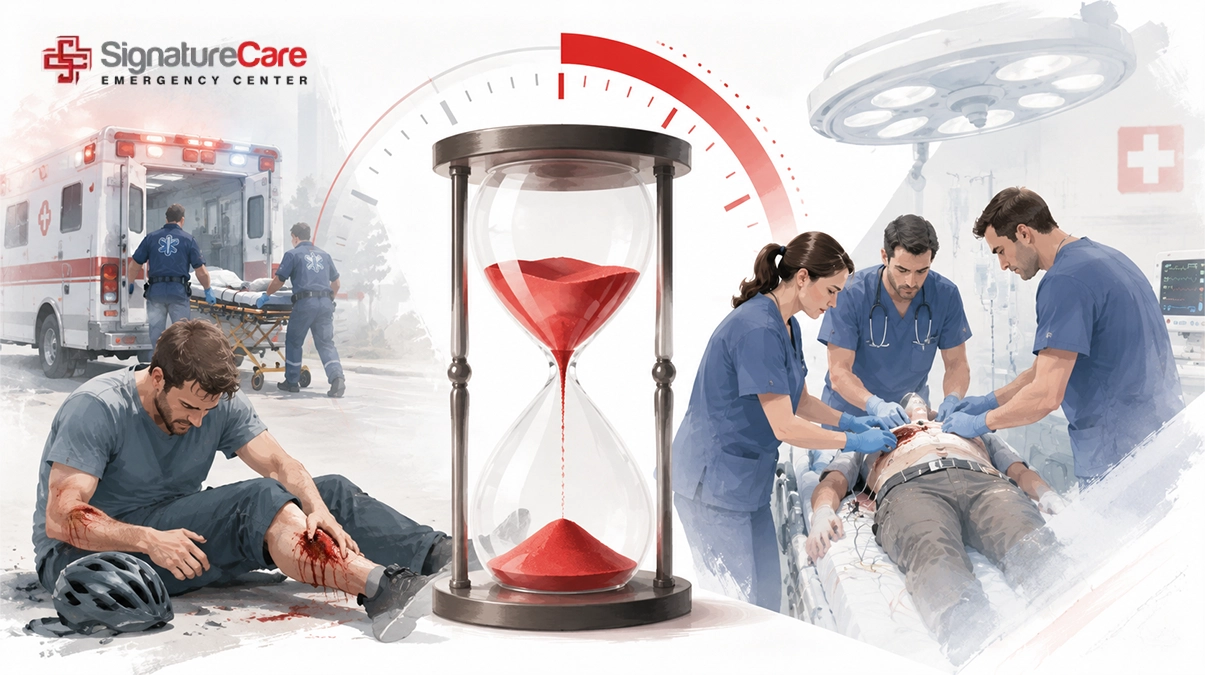
You cannot control when an injury happens. You can control two things: how fast care starts, and whether anyone noted the time of the injury. Both matter more than almost anything else you do at the scene. A simple example: a stitched wound heals in days with a thin scar, while the same wound closed too late fights infection for weeks. The hour you save by coming in now pays back for months.
ER or Urgent Care? The Injury Decision Table
Urgent care has a real place for minor injuries. It also has hard limits, and choosing wrong costs hours. Use this table:
Two honest caveats. Many urgent care clinics have no X-ray after hours, and none can run a CT scan or handle surgical bleeding. If the injury is severe, skip both and call 911. The decision table assumes someone can drive you safely. One more note for parents: children's injuries follow their own rules, and our pediatric emergency guides cover those decisions separately.
Broken Bones, Sprains, and Dislocations
Bones break in more ways than most people expect. Learn the types of bone fractures, because the type changes the urgency. A hairline crack and an open fracture are different emergencies entirely. Open fractures, where bone pierces the skin, carry high infection risk and often need surgery the same day.
Here is the part that surprises patients weekly: a bad sprain can hurt more than a clean break. Swelling, bruising, and pain overlap almost completely, and our ER teams regularly find fractures in patients convinced they had a sprain. The difference between a sprain and a fracture comes down to one thing. An X-ray. Nothing you can check at home settles it.
Dislocations, most often the shoulder, follow one rule: do not let anyone pop it back at the scene. A bad reduction can tear vessels and nerves. Splint it where it sits, support the arm, and come in. We image first, numb the joint, and reduce it properly.
Head and Spinal Injuries: When a Bump Is an Emergency
Most bumps on the head are just bumps. The dangerous ones announce themselves with head injury warning signs that every family should know:
- Loss of consciousness, even briefly
- Vomiting more than once
- A headache that keeps getting worse
- Confusion, unusual drowsiness, or slurred speech
- One pupil larger than the other
- Clear fluid or blood from the nose or ears
- Any head injury in someone who takes blood thinners
That last one matters more each year. Blood thinners turn a minor bump into a possible brain bleed, and the symptoms can take hours to appear. When any of these flags shows up, a CT scan is the only way to see what is happening inside the skull, and we run them on site at every location.
Never Move Someone With a Suspected Spinal Injury
If a fall, crash, or blow leaves someone with neck pain, back pain, numbness, or weakness, do not move them and do not let them get up. Call 911 and keep the head still. The only exception is immediate danger, like fire or traffic. Moving an unstable spine can turn a recoverable injury into a permanent one.
Cuts, Wounds, and When You Need Stitches
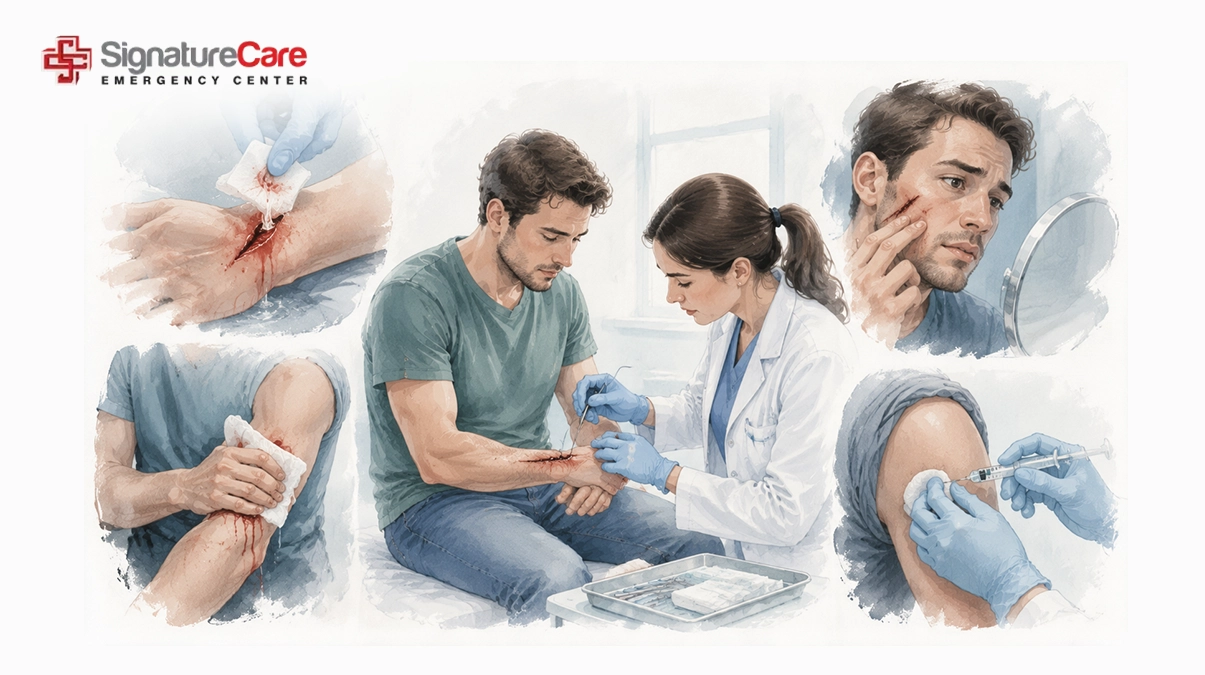
Skin is forgiving. It heals shallow cuts on its own. It needs help when the wound is deeper than it is wide. Get a cut evaluated for stitches when:
- The edges gape open or will not stay together
- You can see fat, muscle, or bone
- Bleeding continues after 10 minutes of firm pressure
- The cut crosses a joint, or sits anywhere on the face
- The wound is dirty, jagged, or came from a bite or rusty object
Timing is the trap. Most wounds should be closed within about six hours of the injury. Wait a day and many cuts can no longer be safely stitched, which means slower healing and a worse scar. Come in early, not after you have watched it overnight.
Deep or dirty wounds raise one more question people forget: tetanus. If your last booster was more than five years ago and the wound is dirty or deep, you need one. You can get a tetanus shot at the ER during the same visit, any hour of the day, and we check your status as part of every wound repair.
Burns: Degrees and When to Go to the ER
Burn severity runs in degrees, and the degree decides the destination:
- First-degree. Red, painful, dry, like a mild sunburn. Usually home care.
- Second-degree. Blisters, wet-looking, very painful. ER if larger than about 3 inches, or on the face, hands, feet, groin, or over a joint.
- Third-degree. White, leathery, or charred skin that may not hurt because nerves are damaged. Always an emergency.
Electrical and chemical burns are ER visits every time, whatever they look like on the surface. The damage runs deeper than the skin shows. Cool a fresh burn under cool running water for 10 to 20 minutes, never with ice, then get burn emergency care if it meets any threshold above.
Bites and Outdoor Injuries
Texas backyards bite. Cat bites look small and are among the worst: those needle teeth drive bacteria deep into tissue, and the infection rate is high enough that punctures deserve medical care the same day. Dog bites tear more than they puncture, and deep ones need cleaning, possible closure, and a tetanus check.
Snake bites follow three rules: keep the person calm and still, keep the bitten limb at heart level, and get to an ER. No tourniquets, no ice, no cutting or sucking the wound. Those movie remedies make outcomes worse. Lightning strikes and serious outdoor injuries follow the same principle: when the mechanism is violent, get evaluated even if the person looks fine.
Call 911 or Drive to the ER?
Call 911 for severe bleeding you cannot stop with pressure, any suspected neck or back injury, major head trauma, open fractures, and large or electrical burns. Never move someone with a suspected spinal injury unless they are in immediate danger. For stable injuries, have someone else drive. The injured person never drives.
Paramedics do more than transport. They control bleeding, immobilize the spine, and radio ahead so the ER is ready the moment you arrive. In smaller Texas markets like Odessa, Killeen, or Texarkana, that head start matters even more, because a freestanding ER can begin stabilization locally while any needed transfer is arranged.
Your First 10 Minutes at the ER
Walk into a SignatureCare ER with an injury and here is the sequence:
- Minutes 0 to 2: Triage on arrival. Severe bleeding, head trauma, and deformed limbs skip the line.
- By minute 10: You are typically with a board-certified ER physician. Our 10-minute wait standard exists for exactly these visits.
- Imaging: On-site X-ray answers the fracture question in minutes. Head, spine, and internal injuries get a CT scan, also on site, at any hour.
- Treatment: Numbing, cleaning, and sutures for wounds. Splinting and reduction for bones and joints. Burn dressing. A tetanus booster if your status calls for one.
- Disposition: Most patients go home with a treatment plan. When surgery or trauma-center care is needed, we arrange transfer with the receiving team briefed before you leave.
Searching for urgent care with an X-ray at midnight is a gamble. Every SignatureCare location runs X-ray, multi-slice CT scan, ultrasound, and a full lab 24 hours a day, every day of the year.
First Aid Do's and Don'ts While Help Is Coming
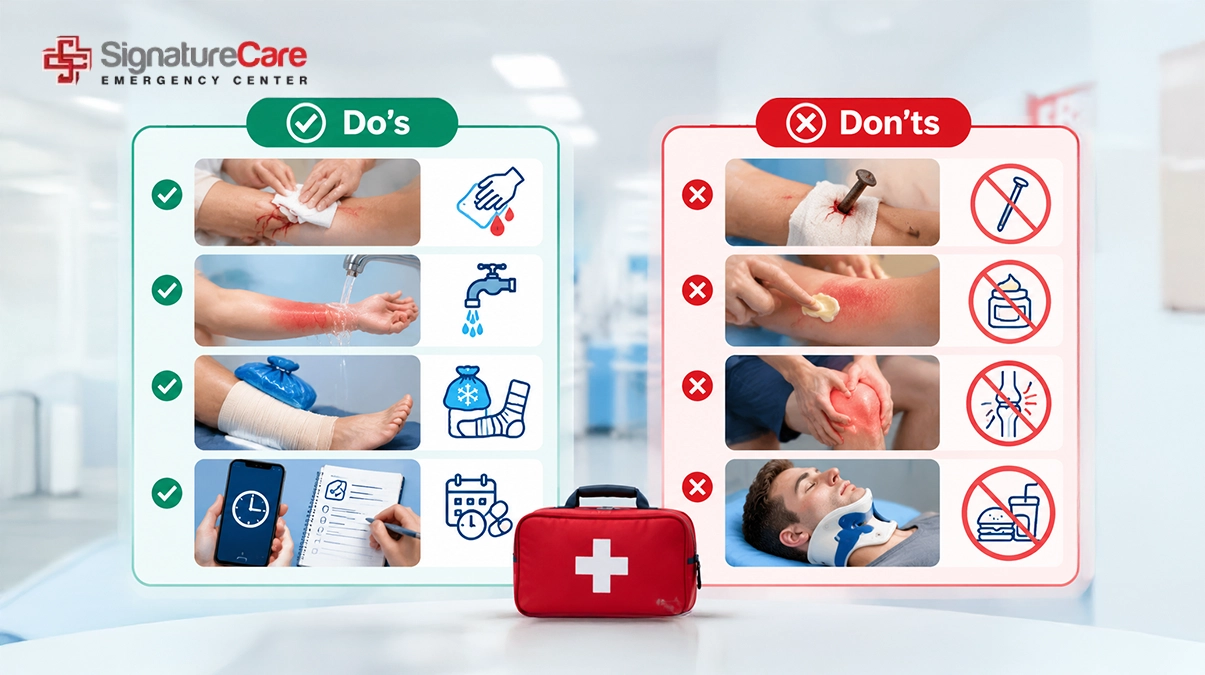
What you do in the first minutes helps us in the first hour. None of it requires training, just calm hands and a short list.
- Do press firmly on bleeding wounds with the cleanest cloth available, and keep pressing.
- Do cool burns under cool running water for 10 to 20 minutes.
- Do rest, ice, compress, and elevate a limb injury on the way in.
- Do note the time of the injury and bring a list of medications, especially blood thinners.
- Don't pull out a deeply embedded object. Stabilize it in place and let us remove it.
- Don't put ice directly on a burn, or butter, or ointments.
- Don't let anyone pop a dislocated joint back in at the scene.
- Don't move a person with possible neck or back injuries, and don't give food or drink to someone who may need surgery.
Find Trauma & Injury Emergency Care Near You in Texas
SignatureCare operates freestanding 24-hour emergency rooms across Texas, each staffed by board-certified emergency physicians with X-ray, CT scan, ultrasound, lab, and pharmacy on site. Walk in any hour. No appointment needed.
North Texas: Frisco · Allen · Flower Mound · McKinney · Preston - Plano
Central Texas: College Station · Killeen
East Texas: Texarkana
Trauma & Injury Article Library
Go deeper on any injury:
Bones and joints: Types of Bone Fractures · Sprain vs. Fracture · Strain vs. Sprain · Intercostal Muscle Strain · Dislocated Shoulder Help · Using Crutches · Using Slings
Head and spine: Head Injuries · Concussions · Concussion Causes and Treatment · Spinal Cord Injuries
Wounds: Cuts and Lacerations · Foreign Body Removal · Tetanus Shots
Burns: Burn Emergency Care · Common Burn Injuries · Kitchen Burns · When Sunburn Turns Serious
Bites: Animal Bites · ER Visits for Animal Bites · Snake Bite: What to Do
Situational: Work-Related Emergencies · Lightning Injuries
Frequently Asked Questions About Injury and Trauma Care
Is a sprain worse than a break?
Sometimes. A severe sprain can hurt more than a small fracture, and the two look nearly identical from outside. Only an X-ray settles it, so get imaging.
Do I need stitches for my cut?
If it gapes open, shows fat or muscle, keeps bleeding after 10 minutes of pressure, or crosses a joint or your face, yes. Come in within six hours.
Do I need a tetanus shot after a cut or bite?
For dirty or deep wounds, you need a booster if your last shot was over 5 years ago. SignatureCare checks your status and gives boosters on site, 24/7.
Can a freestanding ER treat broken bones?
Yes. Freestanding ERs X-ray, set, and splint broken bones on site. Fractures that need surgery are stabilized first, then referred or transferred.
Should I go to the ER or urgent care for stitches?
Deep, gaping, dirty, or facial cuts belong in the ER, where a physician closes the wound and checks tetanus. Urgent care suits only small, simple cuts.
When is a burn an emergency?
Any third-degree burn, a second-degree burn larger than 3 inches or on the face, hands, feet, groin, or a joint, and every electrical or chemical burn.
Should I go to the ER for a cat or dog bite?
Yes for punctures and deep bites. Cat bites push bacteria deep and infect fast. Dog bites often need cleaning, possible closure, and a tetanus check.
Wrapping Up
Every injury on this page gets better outcomes with earlier care. Pressure on the wound, a still spine, a noted time, and a fast trip to the right level of care. Do those four things and you have done your part. We are ready for ours, around the clock.
-----------------------------------------------------------------------------

Dr. Adolfo Alvino, MD, is a board-certified emergency medicine physician based in the Midland-Odessa area in Texas and the Medical Director of SignatureCare Emergency Center in Odessa, TX. He graduated from the Albert Einstein College of Medicine of Yeshiva University in New York and has been in practice for over 10 years. Dr. Alvino specializes in emergency medicine.