By Dr. Christopher L Huerta, MD.
Sudden chest pain or pressure, trouble breathing, a drooping face, arm weakness, or slurred speech can mean a heart attack or stroke. Call 911 right away. Every minute of delay costs heart muscle or brain cells to deteriorate.
SignatureCare Emergency Center provides heart attack and stroke emergency care 24/7 at our freestanding emergency rooms across Texas, with board-certified ER physicians, on-site EKG, CT, and lab testing, and a typical wait time of 10 minutes or less.
Most people hesitate at the worst possible moment. They wait. They search for their symptoms. They call a family member first. This article gives you the answers before you need them.
Below you will find the warning signs of each emergency, how to tell them apart, what to do while help is on the way, and what happens in your first minutes at the ER.
What Counts as a Heart or Stroke Emergency?
A cardiac or stroke emergency is any sudden failure of blood flow to the heart or the brain. Both organs need a constant oxygen supply. Cut that supply off for a few minutes, and cells begin to die. That is why these events are treated minute by minute, never wait and see.
SignatureCare ER physicians evaluate and stabilize:
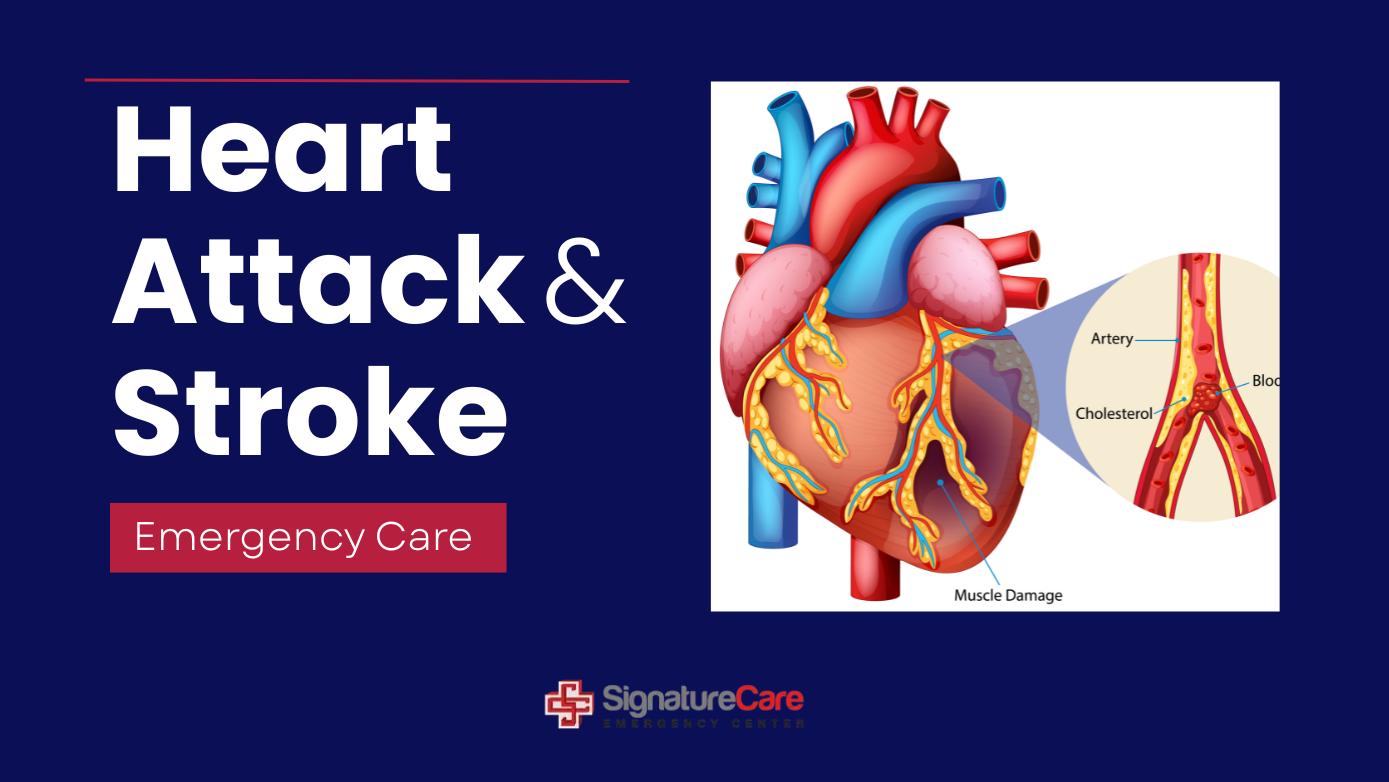
- Heart attack (myocardial infarction). A blocked artery starves part of the heart muscle.
- Stroke. A clot or a bleed cuts off part of the brain.
- Transient ischemic attack (TIA). A temporary blockage in the brain, often called a mini stroke.
- Cardiac arrest. The heartbeat stops completely, and the person collapses.
- New or irregular rapid heartbeat. Including atrial fibrillation, a quivering rhythm in the heart's upper chambers.
- Emergency chest pain. Pressure, squeezing, or pain that will not ease up.
- Dangerously elevated blood pressure. Sudden severe spikes can injure the heart and brain and require hypertensive emergency treatment without delay.
One thread connects most of this list: a blood clot in the wrong place. The same kind of clot that blocks a heart artery can block a brain artery. That is why heart and stroke care belong on one page.
Heart Attack Warning Signs (Women's Symptoms Included)
Learn the heart attack warning signs before you need them, because recognizing them early is half the battle. The classic pattern looks like this:
- Chest pressure, squeezing, or fullness that lasts more than a few minutes, or goes away and comes back
- Pain spreading to the arm, jaw, neck, or back
- Shortness of breath, with or without chest discomfort
- Cold sweat, nausea, or lightheadedness
- Sudden, unexplained exhaustion
Women often get the quiet version. Chest discomfort still leads, but the pressure can be mild or even absent. Watch for unusual fatigue, breathlessness, nausea, and back or jaw pain. Many women describe it afterward as feeling like the flu. It was not the flu.
Our ER teams see the same story every week: someone sat at home for 2 hours because the pain wasn't that bad. The heart muscle died while they waited. If symptoms last more than a few minutes, treat it as a heart attack until a physician proves otherwise.
SkiptheWaitBook an Appointment Today
Stroke Warning Signs: Think BE-FAST
Stroke announces itself suddenly, and the BE-FAST checklist catches more strokes than the older FAST version because it adds balance and eyes, the two clues families miss most. Review the stroke warning signs with the people you live with, then memorize six letters:
- B, Balance. Sudden loss of balance or coordination.
- E, Eyes. Sudden blurred, double, or lost vision in one or both eyes.
- F, Face. One side of the face droops when the person smiles.
- A, Arms. One arm drifts down when both are raised.
- S, Speech. Slurred, garbled, or missing words.
- T, Time. Any of the above means call 911 now, and note the time symptoms started.
Stroke Symptoms That Go Away Still Need the ER
Symptoms that vanish after a few minutes feel like a relief. They are a warning. A transient ischemic attack (TIA) is a temporary blockage in the brain, and the risk of a full stroke is highest in the first hours and days after one. Do not sleep it off. Come in, get evaluated, and give your care team the chance to prevent the real thing.
Heart Attack vs. Stroke vs. Cardiac Arrest: Know the Difference
A heart attack is a circulation problem: blocked blood flow damages the heart muscle while the heart keeps beating. A stroke is the same problem in the brain. Cardiac arrest is an electrical problem: the heart suddenly stops beating. All three are 911 emergencies.
| Heart attack | Stroke | Cardiac arrest | |
| What happens | The artery to the heart is blocked | An artery in the brain is blocked or bursts | The heart's electrical system stops the heartbeat |
| Organ under attack | Heart muscle | Brain | Whole body (no circulation) |
| Hallmark signs | Chest pressure, arm or jaw pain, sweating, nausea | Face droop, arm weakness, slurred speech, vision, or balance loss | Sudden collapse, no response, no normal breathing |
| Is the person conscious? | Usually Yes | Usually Yes | No |
| First move | Call 911, stay still, chew aspirin only if told to | Call 911, note the time, no aspirin | Call 911, start chest compressions immediately |
| How the ER confirms it | EKG plus troponin blood test | CT scan of the brain | Rhythm monitor and immediate resuscitation |
The three overlap in one dangerous way. A heart attack can trigger cardiac arrest. Untreated atrial fibrillation lets clots form that travel to the brain, raising stroke risk about five times. Treating one condition early often prevents the other.
When Chest Pain Is an Emergency
Chest pain is one of the most common reasons Americans visit an emergency room, and the most second-guessed. Not every ache is a heart attack. Muscles, ribs, gas, acid reflux, and anxiety all cause chest pain, too. Our guide to the types of chest pain explained goes deeper. When you need an answer fast, use this table.
| Go to the ER now | See your doctor this week |
| Pressure or squeezing lasting more than 5 minutes | A brief twinge that changes when you move or press on it |
| Pain spreading to the arm, jaw, neck, or back | Soreness after exercise or an injury |
| Chest pain with sweating, nausea, or shortness of breath | Mild burning after meals that antacids relieve |
| Fainting, near fainting, or a racing, irregular heartbeat | Occasional discomfort that has been stable for weeks |
| Any chest pain with stroke-like symptoms | Mild symptoms your doctor is already managing |
Heartburn is the classic impostor. It burns behind the breastbone after meals, gets worse lying down, and eases with antacids. Heart attack pain is more often pressure, comes with sweating or breathlessness, and antacids do nothing. Our guide on when to go to the ER for heartburn covers the difference in depth. Still unsure? Come in. That is what we are here for.
Call 911 or Drive to the ER?
Call 911 for any suspected heart attack or stroke. Do not drive yourself. Paramedics begin treatment on the way, alert the ER before you arrive, and can respond immediately if your condition worsens en route. Have someone drive you only when an ambulance cannot reach you quickly.
The math favors the ambulance every time. Emergency crews run an EKG in your driveway, transmit it ahead, and start oxygen, IV access, and medications miles before the ER doors. The American Heart Association gives the same advice for a simple reason: patients who arrive by ambulance are treated faster.
A ride from a family member is reasonable only for milder, less classic symptoms. The patient never drives. A heart attack or stroke behind the wheel endangers you and everyone else on a Texas highway.
One more Texas reality: in markets like Odessa, Killeen, or Texarkana, the nearest full hospital can be a long drive away. That is the gap that freestanding ERs like SignatureCare Emergency Center close. Stabilization, diagnosis, and emergency treatment start locally while transfer is arranged.
SkiptheWaitBook an Appointment Today
Your First 10 Minutes at the ER
Speed is the entire point of an emergency room. Here is what happens when you walk into a SignatureCare ER with heart or stroke symptoms.
- Minutes 0 to 2: You are triaged on arrival. Chest pain and stroke symptoms skip the line.
- By minute 10: An EKG records your heart's electrical activity. National guidelines call for an EKG within 10 minutes of arrival for chest pain, and our typical wait of 10 minutes or less is built around that standard.
- At the same time: The on-site lab draws blood for a troponin test, a protein that confirms heart muscle injury.
- For stroke symptoms: A CT scan of the brain shows whether a clot or a bleed is to blame. That single answer decides the treatment.
- Then: The ER physician starts treatment and, when hospital admission is needed, arranges rapid transfer with the receiving team already briefed.
Why the urgency? Because treatment windows are short and unforgiving:
| Emergency | Treatment | Window that saves the most tissue |
| Heart attack | Clot-dissolving medicine and artery-opening procedures | Works best in the first 1 to 2 hours after symptoms start |
| Ischemic stroke | Clot-busting medicine | Within 3 hours of onset, up to 4.5 hours for selected patients |
| Cardiac arrest | CPR and defibrillation | Minutes. Survival drops with every minute without CPR |
Every SignatureCare location runs multi-slice CT scan and ultrasound imaging on site, 24 hours a day. The full cardiac and stroke workup happens when you walk in.
While You Wait for Help: Do's and Don'ts
The minutes before the ambulance arrives matter. Here is how to use them.
- Do sit or lie down, and loosen tight clothing.
- Do note the exact time symptoms started. Treatment windows depend on it.
- Do chew one adult aspirin for a suspected heart attack, but only if the 911 dispatcher or a doctor tells you to.
- Do start chest compressions if the person collapses and is not breathing normally: push hard and fast in the center of the chest, 100 to 120 pushes per minute, until help arrives.
- Don't take aspirin for stroke symptoms. Some strokes are bleeds, and aspirin can make them worse.
- Don't eat, drink, or take extra blood pressure medicine while you wait.
- Don't drive yourself, and don't wait to see if it passes.
Lowering Your Risk of Heart Attack and Stroke
Heart attack and stroke share the same six levers: blood pressure, cholesterol, smoking, diabetes, weight, and inactivity. Move any one of them and both risks fall together. That is the quiet good news inside a scary topic. Movement is the cheapest medicine of all. Thirty minutes of brisk walking most days measurably lowers both risks.
If you have atrial fibrillation, treat it like the stroke risk it is. The quivering rhythm allows clots to form in the heart and travel to the brain. Rhythm control and blood-thinning care from your doctor cut that risk sharply.
The prevention guides in the library below take each lever in turn, in plain language.
Find Heart & Stroke Emergency Care Near You in Texas
SignatureCare Emergency Center operates freestanding 24-hour emergency rooms across Texas. Every location is staffed by board-certified emergency physicians and equipped with on-site EKG, CT scan, ultrasound, lab, and pharmacy. Walk in any hour of any day. No appointment needed.
Dallas-Fort Worth: Frisco · Allen · Flower Mound · McKinney · Preston - Plano
Bryan-College Station: College Station · Bryan and Aggieland (coming soon)
Central Texas: Killeen
Northeast Texas: Texarkana
Every Minute Counts
Heart attacks, strokes, and cardiac arrest punish hesitation. Know the warning signs, call 911 first, note the time, and let the professionals move fast. The treatments work. They just need you in the building early.
For more heart and stroke education, the American Heart Association is the leading US authority.
Frequently Asked Questions About Heart and Stroke Emergencies
What is the difference between a heart attack and a stroke?
A heart attack blocks blood flow to the heart. A stroke blocks or bursts a vessel in the brain. Both need 911 and emergency care right away.
What is the difference between a heart attack and cardiac arrest?
A heart attack is a blood flow problem. Cardiac arrest is an electrical problem that stops the heartbeat, causes collapse, and needs CPR at once.
Should I take aspirin if I think I'm having a stroke?
No. Some strokes are caused by bleeding, and aspirin can make them worse. Only chew aspirin for a suspected heart attack if 911 dispatch advises it.
What if my stroke symptoms went away on their own?
Get emergency care anyway. It may have been a TIA, a warning stroke. The risk of a full stroke is highest in the first days after a TIA.
Can heartburn feel like a heart attack?
Yes. Heartburn burns after meals and eases with antacids. Pressure with sweating, breathlessness, or arm pain points to the heart. When unsure, come in.
Can a freestanding ER treat a heart attack or stroke?
Yes. SignatureCare runs EKGs, troponin blood tests, and CT scans on site, starts treatment immediately, and arranges rapid hospital transfer when needed.
How fast will I be seen at SignatureCare Emergency Center?
Most patients are seen by a board-certified ER physician in about 10 minutes or less, any hour of the day, with no appointment needed.
Heart & Stroke Article Library
Go deeper on any topic in this cluster:
Heart attack: Heart Attack Symptoms · 3 Heart Attack Risk Factors
Stroke: 4 Signs You Might Be Having a Stroke
Heart rhythm: Living an Active Life with AFib · Tachycardia
Chest pain: Understanding the Types of Chest Pain · Chest Pain Symptom Guide
Blood clots: Blood Clots
Blood pressure: Hypertensive Emergencies · 10 Signs of High Blood Pressure
Heartburn or heart? GERD and Upper Gut Pain · ER for Heartburn · Heartburn Self-Help Remedies
Prevention: 8 Ways to Reduce Heart Disease Risk · 6 Ways to Lower Cholesterol · 5 Tips for a Healthy Heart · Maintaining Good Cardiac Health
-----------------------------------------------------------------------------
Dr. Christopher L Huerta, MD, is a board-certified emergency medicine specialist based in Midland, TX, and the Medical Director of SignatureCare Emergency Center in Midland, TX. He received his medical degree from Washington University in St. Louis School of Medicine and has been in practice for more than 40 years.